
Perry County Court Records After Arrest
After a Perry County jail arrest, the most useful online record is usually the court docket rather than a jail roster. Perry County does not publish a county-hosted inmate roster with formal charge details. The booking basis may come from a police complaint, warrant, or commitment paperwork, but the charges that matter in court are tracked through the Pennsylvania Unified Judicial System. That docket can show the case number, defendant name, OTN, charge text, grade, status, hearings, filings, bail entries, and disposition.
The arrest side still matters. Current custody is confirmed through Perry County Prison, PA SAVIN/VINELink, or a records request, while formal court records after a jail arrest are searched through UJS and the Perry County Clerk of Courts. For custody and booking channels, use Perry County jail inmate records. For booking-photo questions, use Perry County jail mugshots. Those records may point to the same event, but each agency controls a different part of the process.
The Perry County District Attorney is F. Clay Merris IV. The DA is described by the county as the chief law enforcement officer for prosecution work, including criminal complaints and case prosecution. Sheriff David Hammar serves warrants through the Sheriff Office and oversees prisoner-transport duties for court appearances. Those local roles explain why an arrest can generate more than one record: a jail custody record, a warrant or transport event, a prosecutor charging decision, and a court docket.
Find Perry County Court Records
The official statewide search point is the Pennsylvania UJS case-search portal. UJS provides public docket-sheet access for criminal Courts of Common Pleas, Magisterial District Courts, and other Pennsylvania courts. Recent entries may lag, so a docket should not be treated as a real-time release record. Bail entries can appear on a docket, but release still depends on processed court orders and any other holds at the jail.
The UJS case-search screen is the best image match for this court-record page because it is where Perry County criminal dockets are searched after an arrest.
Open the UJS case-search portal to search the public docket system that supports Perry County court records after a jail arrest.
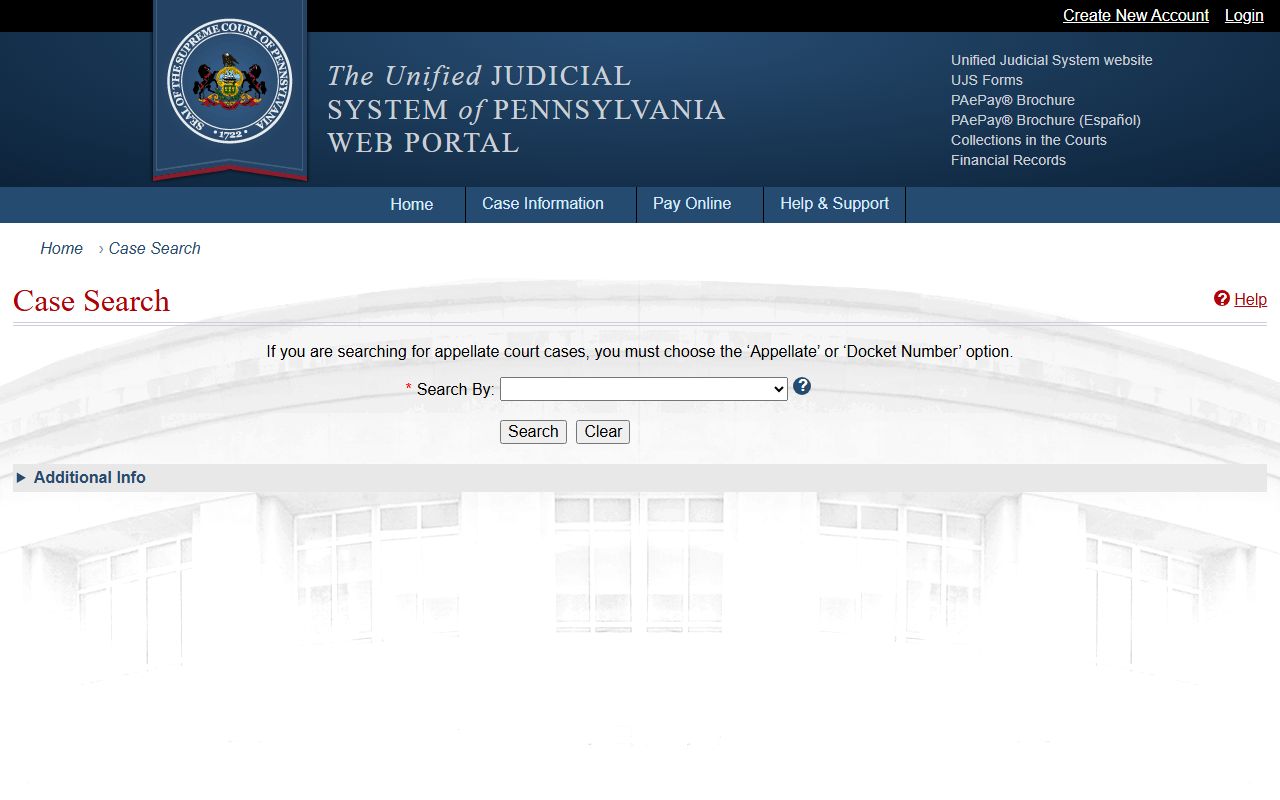
The portal is a court-record source, not a jail custody roster. Use it for charges and case events, then confirm custody through Perry County Prison or PA SAVIN when release timing matters.
| Search Field | Best Use | Notes |
|---|---|---|
| Case or Docket Number | Known court paperwork | Most precise when the docket number is available. |
| Participant Name | Defendant name search | Use full legal name and date of birth if known. |
| OTN | Arrest-to-court match | The offense tracking number can connect arrest paperwork to court entries. |
| Police Incident or Complaint Number | Police paperwork | Useful when early paperwork lists the complaint number. |
| SID | State identifier | Helpful only when the state ID number is already known. |
Search Court Records After Arrest
Start with the information closest to the arrest. A name-only search can work, but a docket number, OTN, or police complaint number reduces false matches. Early Perry County cases may begin at the Magisterial District Court level and later move to the Court of Common Pleas if the charge is held for court. Check both levels when the first search does not show the case.
- Search UJS by docket number, OTN, police complaint number, or participant name.
- Open each possible criminal docket and compare the name, date, court, and charge list.
- Read the charge status, grading, docket dates, bail entries, and next court events.
- Contact the Perry County Clerk of Courts when certified copies or older file review is needed.
- Confirm jail custody separately through Perry County Prison or PA SAVIN/VINELink.
For certified or file-copy needs, the Perry County Clerk of Courts lists Clerk Zoe Burd at 2 East Main Street, PO Box 325, New Bloomfield, PA 17068, phone 717-582-2131, fax 717-582-5167, with public office hours Monday through Friday from 8 a.m. to 4 p.m.
Perry County Charging Records
Court records after a Perry County arrest come from charging documents and docket events. A criminal complaint may start the case. An information may be filed by the prosecutor after the case advances. An indictment is less common in routine county practice but remains a formal charging route in serious cases. The key point is that the jail booking reason can differ from the charge list that later appears in court.
| Document | Who Files It | What It Does |
|---|---|---|
| Complaint | Police officer or prosecutor | Starts many criminal cases and states alleged offenses. |
| Information | District Attorney | Sets formal Common Pleas charges after preliminary proceedings. |
| Indictment | Grand jury process | Charges serious matters through grand-jury action where used. |
The Perry County District Attorney page is useful for source context because it describes prosecution duties, private criminal complaint review, and victim-witness services. It does not replace the docket. Use UJS or the Clerk for the actual court record.
Perry County Charge Status
Charges can change after arrest. A docket may show a count as pending, held for court, amended, reduced, dismissed, withdrawn, disposed, or nolle prosequi. A pending charge is not a conviction. A dismissed or withdrawn count may still appear in a historical docket unless it is later restricted under Pennsylvania law. Read each count separately because one case can have several charges at different stages.
| Status | Plain Meaning | Why It Matters |
|---|---|---|
| Pending | The charge is active and unresolved. | Future hearings or filings may still occur. |
| Held for Court | The charge moved toward Common Pleas proceedings. | The case may appear in a higher court docket. |
| Amended or Reduced | The wording, count, or grade changed. | Do not rely on the first arrest charge alone. |
| Dismissed or Withdrawn | The count was removed or not pursued. | It is not a conviction, though it may remain visible unless restricted. |
| Nolle Prosequi | The prosecutor declines to proceed on that count. | The disposition should be read with the full docket history. |
Bail Records After Arrest
Bail is set by a judicial officer or court process, not by the jail acting on its own. Pennsylvania release categories can include release on recognizance, unsecured bail, nominal bail, monetary bail, surety or property security, or detention/no release by court order. A person can also remain in custody because of another county warrant, probation or parole detainer, federal hold, state DOC hold, or immigration context.
PAePay Bail is the statewide online bail-payment portal where the court and case participate. The UJS payment page states that major cards and ATM cards may be used and that a non-refundable 2.75% service fee applies. Do not assume Perry County online bail is available for every case. Check the subscribed-courts list and the docket, then confirm with the Clerk or issuing court.
The PAePay Bail portal screenshot fits this section because bail entries are often reviewed beside Perry County court records after arrest.
Review PAePay Bail only after checking the docket and court participation for the specific Perry County case.
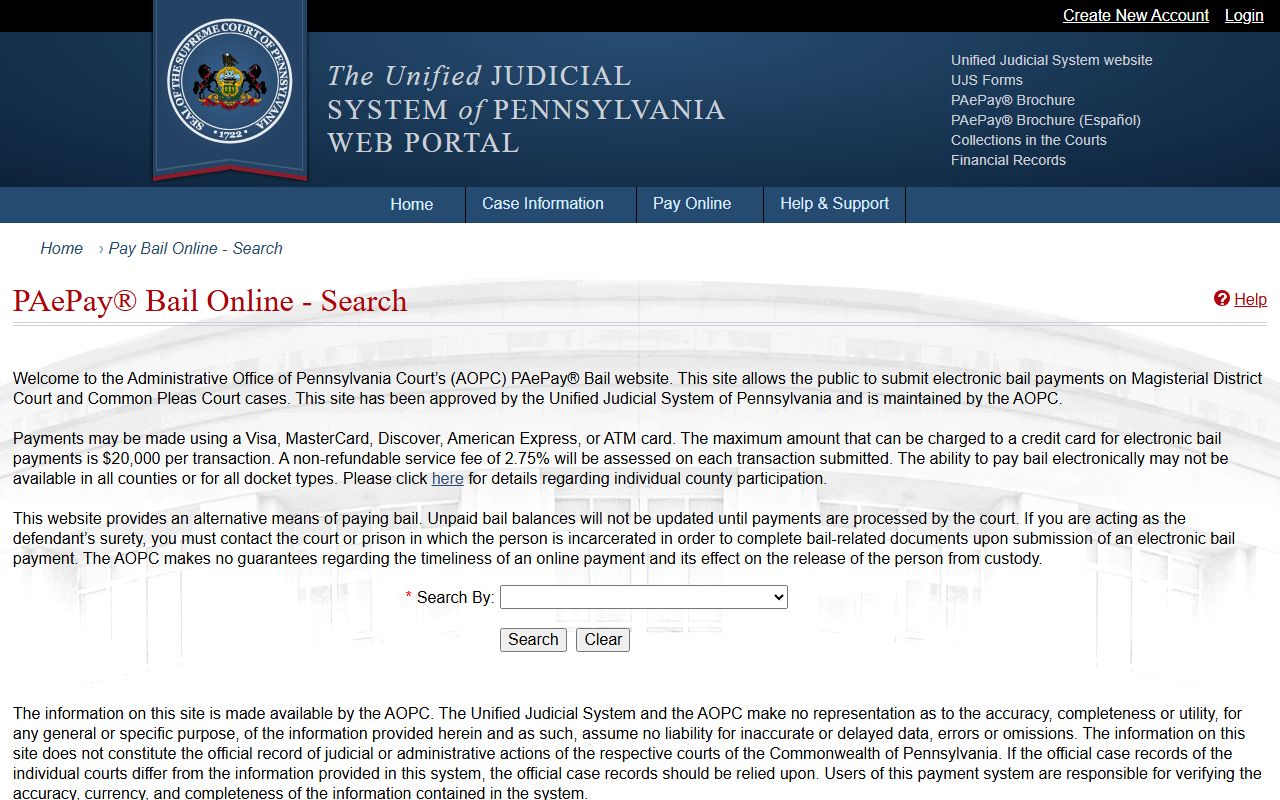
Even when a payment is accepted, the jail release step depends on court processing and any separate detainers or holds.
Warrants and Arrest Records
No official Perry County Sheriff active-warrant web search was found in the research. The Sheriff Office page says the office serves court-issued warrants and transports prisoners, so it is part of the custody path, but it should not be described as running a public online warrant roster. UJS dockets may show bench-warrant events or court status. The Sheriff Office phone is 717-582-5123, and courthouse hours are Monday through Friday, 8 a.m. to 4 p.m.
- Arrest warrant
- A court order authorizing arrest based on alleged conduct or a complaint.
- Bench warrant
- A judge-issued warrant, often tied to failure to appear or noncompliance.
- Detainer
- A hold from another agency or jurisdiction that can block release.
Active warrant questions can carry legal risk. UJS, the issuing court, the Sheriff Office, and legal counsel are better sources than private name-search sites.
Charges and Convictions Compared
Arrest, charge, and conviction mean different things. A Perry County jail arrest is a custody event. A charge is an accusation filed in court. A conviction requires a guilty plea, verdict, or other finding that resolves guilt. Court records after arrest may show all three stages over time, so the docket should be read by count and date.
| Record Type | Stage | What It Proves |
|---|---|---|
| Arrest | Custody or enforcement event | Shows that a person was taken into custody, not guilt. |
| Charge | Formal accusation | Shows the offense alleged by the complaint or prosecutor. |
| Conviction | Disposition after plea or verdict | Shows a formal finding or plea outcome. |
UJS docket sheets are also not a complete Pennsylvania State Police criminal-history report under CHRIA. Use the proper state background-check process when a legally valid criminal-history report is required.
Sealed and Expunged Court Records
Pennsylvania record access is limited by the Right-to-Know Law, CHRIA, court rules, juvenile confidentiality, and criminal-investigative exemptions. RTKL defines records broadly enough to include documents, photos, recordings, electronic records, and image files held by agencies. Section 708(b)(16) can still allow agencies to withhold criminal-investigative material. CHRIA also governs dissemination of criminal history record information. For Perry County court records after arrest, the practical split is limited access versus expungement.
| Issue | Sealed or Limited Access | Expunged |
|---|---|---|
| Public view | Access is restricted for eligible records under 18 Pa.C.S. § 9122.1 or Clean Slate rules. | The qualifying record is removed under court authority through 18 Pa.C.S. § 9122. |
| Agency access | Criminal-justice access may still exist where the law permits it. | Access is more limited because the record is treated as removed. |
| Best use | Common for eligible records that should not be shown on public internet searches. | Common for qualifying no-disposition, summary, or court-ordered situations. |
Investigative exemptions are separate. RTKL Section 708(b)(16) may still limit police or prosecution records even when a docket remains visible.
Important: A docket search is not an FCRA consumer report and should not be used for credit, employment, insurance, or tenant screening.